Uncategorized

4 Steps to a Second Career (Without Going Broke!)

Its a lot of fun to run a winery.  Its so much fun, in fact, that many are willing to run one at a loss.  The same goes for other industries, like hobby farms, breweries and coffee houses.  But most confess that living the dream is more fun if it doesn’t drain the retirement fund, and on that topic I learned some good wisdom from the owner of an excellent coffee house.  

Steve Hines had built a successful event-planning company by the time he and his wife Beth decided to start a coffee shop near their home in Gardner, Kansas.  I’ve known Steve for a long time, and know the idea behind Groundhouse Coffee was to unite the community (i.e., no profit motive).  But, as often happens when a company serves customers selflessly, it turned into a decent little business.  Naturally, I interrogated Steve over a cup of coffee.  

Here are the lessons learned on launching a second career:

1.  Scale according to your resources.  The Hines’ built the shop within their means, and left some cash available for operating expenses.  If they’d had less cash, they would have built it smaller.  There’s no reason to stretch; if the idea won’t work when its small, it likely won’t work when it gets bigger. 

2.  Plan.  Groundhouse Coffee existed on paper well before the couple bought the building and hired the staff.  Even if you’re self-funded, it’s a great idea to build a business plan on paper as if it were being offered to investors.  The process forces you to think it through, and paper is a lot cheaper than bricks. 

3.  Learn.  Steve read a lot about running a coffee shop.  He had visited a lot of coffee shops.  And when the place opened, he spent a lot of time in his own coffee shop.  Its also a good idea to take a part-time job or volunteer position in the industry you want to join.  It’s easy to get a job when you offer to work for free, and the lessons learned from the “inside” are well worth the effort. 

4.  Borrow some talent.  Knowing that he didn’t know everything about running a coffee shop, Steve recruited somebody that did: a former manager from Starbucks.  He wisely got her on board from the beginning, so the plan could take shape with her input.  

If you ever find yourself visiting Kansas City, stop by Groundhouse.  It is, in my humble opinion, the finest coffee house atmosphere available in the United States.   http://www.groundhousecoffee.com

Image  Christian   

Standard
Uncategorized

What Would Dave Ramsey Do?

Rachel and I have the privilege of hosting Dave Ramsey’s Financial Peace University at church, starting next week.  If you are familiar with Dave Ramsey, you know he’s been on a mission to get America financially fit for two decades, a quest he began after filing for personal bankruptcy and learning a great deal in the process.

Dave has a simple plan for personal finances, and has recently adapted it to small business. His plan is based on Biblical principles, most notably:

Just as the rich rule the poor, so the borrower is servant to the lender.  Proverbs 22:7

This verse gets some serious reactions, it turns out.  Everything from:

That’s just old-fashioned and ridiculous. You can’t run your business without debt, much less your life.  How do you ever grow, or get the stuff you want?

to:

I can’t believe the impact this wisdom has had on my life and my business.  I wish I would have adopted the mindset earlier!

After having a few dozen conversations on the matter of debt, please allow me to share a few observations:

1.  The Bible does not say it is wrong to be in debt.  It only explains the risk (becoming a servant to the lender.)  

2.  A person can obviously make more money faster when using debt, for example by borrowing at 4% to invest in an opportunity that pays 6%.  (A person can also lose money faster if the assumptions aren’t correct, or conditions change.)

3.  One’s mindset changes when holding cash.  Personally, I have been tempted to buy things with borrowed money (for fun or business) that I wouldn’t have forked over the cold, hard cash for if it had been in my possession.

4.  Nobody ever opens up and says “man, I sure wish I would have leveraged more.”  

5.  There are some folks out there who have made a great deal of money without using debt, including Dave Ramsey himself.  Apple, Bed Bath and Beyond, to name a few, also operate without debt.  

6. And there are a lot of finance professors with incredible understanding of financial leverage who are broke.

What does this mean for a small business or farm?  Everything.  You can’t go bankrupt if you don’t owe money.  You can’t be forced to sell anything, and you don’t have to send your financial statements to the bank so they can tell you if you’ve violated a loan covenant.  

Just like Dave, I’ve had the privilege of trying both strategies.  And just like Dave, I promise that life is more peaceful with a deep respect for Proverbs 22:7.  


Standard
Uncategorized

The Secret Rules of Selling

I once walked into a winery in Napa Valley, on a mission to do some research for a consulting job. I walked out with the research, PLUS a nice bottle of wine that I hadn’t planned on buying, but was thrilled to show my wife. Why? Because the man knew how to sell.

A salesman called Six Sigma Ranch last week, on a quest to sell me his hot sauce for our wine tasting room. It was an awkward conversation, not because he wasn’t a nice guy, or because he wasn’t selling a good product, but because he broke the rules of selling. We’ve all seen the great salespersons, the ones that connect us with exactly what we need, and we’ve all seen the other guys. Here’s the secret that sets them apart:

A great salesperson understands that there are 4 distinctive steps to selling anything.

1. Qualification: Does the prospect (potential customer) have the need for, AND means to purchase, what you’re selling? If not, you have no business selling them anything. That was the rule Mr. Hot Sauce broke; hot sauce is a terrible pairing with wine, and thus I wasn’t a qualified customer.

2. Rapport: People buy what they need and want from those they KNOW, LIKE, and TRUST. This means you have to take the necessary time to build rapport through honesty and conversation. Also get a chance to know the customer by asking questions, and to determine if your products really do fill a need. And note that rapport evaporates; if you sold a man a butchered steer last year, you may need to rebuild some rapport 12 months later, before selling him another one.

3. Education: Once the prospect trusts you (but not before!) you can begin offering him or her information about your product. At a farmer’s market, this means you start by chatting with a customer, and THEN tell them about your products. Normally, a customer will indicate that he or she is ready for the “education” by asking questions.

(Note, at this point nobody has forced anybody into anything yet, and nobody feels awkward!)

4. Close: The final, most dreaded step, is the close. But it shouldn’t be dreaded. If you did steps 1-3, the close comes automatically. If it doesn’t come automatically, or with a friendly nudge (ex. “would you like me to ship that for you?”) refer back to the beginning.

BONUS: When we added pastured meat to our offerings at Six Sigma Ranch, it at first surprised me how easy it was to sell. But it shouldn’t have. Most of our existing wine customers also enjoy quality meat, and they had already completed steps 1 and 2. As soon as they learned that we sold meat, they asked for brief “education” on the product, and closed the deal with limited fanfare. I learned that adding quality, complimentary products can quickly fill more needs for your existing customers.

Standard
Uncategorized

Joel Thinks You Can Farm . . . . . Do You?

In Joel Salatin’s book, You Can Farm, he really believes that you can.  In 1998 Joel was laying groundwork for people with a dream.  The first section is actually titled ‘Envisioning Your Future.’


One of the biggest mistakes I’ve done in my own life is what can be called “failure to launch.”  Getting a good idea and then letting it sit until the fire has gone out; what a waste.  Joel encourages or demands that we start immediately.  This seems to be true no matter your dream.  If you really want to farm, you need to start in your own backyard.  You need to make something that you love to eat and grow.


So, note to self: Work on your dream today.  Don’t wait for huge amounts of capital.  Understand the difference between wants and needs.  Start small, rent, borrow, beg, and Go for it.


Oh, and read Joel’s book:  “You Can Farm”  (Amazon).


-Rachel

pigs and fence

Standard
Uncategorized

Pick Your Battles, Farmer Brown.

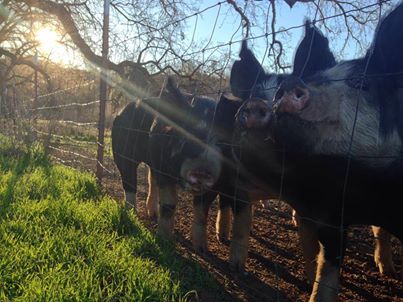
 There is no saying, as far as I know, that goes “thriving like a pig in an oak woodland.”  But there should be.  Watching the Berkshire hogs at Six Sigma Ranch shovel the black topsoil in the woods with their noses in search of acorns is a joy.  They’re even happier than the cows in the pastures, and certainly happier than the neighbor’s cows.  Since I am curious by nature, I wondered why.

Image
 Likewise, the grapes thrive.  There’s no place in the world better for growing grapes than Lake County (although our friends from Napa Valley, with whom Lake County shares a border, might argue for a tied game.)   The small beehive buzzes with enthusiasm.  But the apple tree by an old homestead near the tasting room only survives, and makes decent apples most years, but they’re not world-class.

 This made me think.  What do pigs, grapes and bees all have in common, that apples and cattle don’t?  They were here when we got here!  Lake County is home to wild pigs, wild grapes and wild bees.  And those all do great when we plant them on purpose.  But there are no wild apple trees or bovines here.  This seems obvious now, but I never thought about it as a rule for farming before:  When faced with a new plot of land, what should you plant?  Start with what’s already there!  Trying to make a living growing apples in our Mediterranean climate?  That would be a waste of time. 

On that note, Lake County is full of wild turkeys and quail.  So you might see some pastured poultry with a Six Sigma logo on it in the future.  And the blackberries invading the sheep pasture suggest that jam would be a good idea.  It sounds like we will have plenty of options for Farm-to-Table dinners in the next few years.

Christian

Standard
Uncategorized

How to Price a Product (Part 2/2)

The second aspect of pricing a product, then, is “what do you need to make?”  There’s room for some artistic license here, but “two times variable costs” is a good rule of thumb.  To explain, let’s start with two definitions:

Fixed Costs:  The money it takes to run your farm or business, without ever making a product.  This includes property taxes, building maintenance, and most electricity bills.  Conveniently, in a small farm, many of the fixed costs are part of running your household anyway. 

Variable Costs:  These increase when you make a product.  For example, chicken feed for broilers is a variable cost.  It increases only when you’re feeding a chicken for sale.  Packaging for eggs is also a variable cost.  Labor directly related to production is a variable cost, like the hourly rate for feeding the chickens. 

Lets go back to the egg example, a dozen eggs selling for $6.  As mentioned before, the variable cost (also known as cost of goods sold in this case), should be half of the selling price.  Thus, if you can make a dozen eggs with $3 in variable cost, and sell it for $6, you make a $3 gross profit per dozen, and should be decently happy with yourself. 

The gross profit, of course, exists to first absorb your fixed costs (if you sell 1,000 dozen eggs, your gross profit can absorb $3 x 1,000 or $3,000 of fixed costs).  Once your fixed costs are absorbed, the rest is PROFIT!

To summarize, (1) the market determines price in direct competition.  You determine price when you have a unique product that customers want.  (2) You should be happy to sell your product for two times the variable costs you spent to produce it.  And (bonus), once your gross margin (the money left over after variable costs are covered) exceeds your fixed costs, you make a profit!

That’s a mouthful, I know.  Write me a note or a comment with any questions!

Christian


Standard
Uncategorized

How to Price a Product (Part 1/2)

“If I sell eggs and lose $1 per dozen, how many dozen do I have to sell to break even?”  It’s a silly question, of course, but I’ve seen countless well-meaning farmers try to answer it by trial-and-error, on their way to getting a job in town.

I’d rather ask, “if I sell eggs and make $3 per dozen, how many do I have to sell to quit my job in town and make my dream job my real job?”

What’s the difference between the two farmers asking the questions? One of them knows how to price a product for sale. 

There are two aspects to pricing any product:

1.  What will the customer pay?

2.  What do you need to make?

Let’s start with the first one, “what will the customer pay?”  It’s really the most important, because it doesn’t matter what you need to make on a product if no customers will buy it at that price.  To begin, consider existing pricing in the market for products similar to yours.  If three farmers in your town are selling a dozen eggs for $6, that’s probably what people will pay.  Its not likely, if your eggs cost $9, that people will buy them.  That is, UNLESS (and this is a BIG idea when it comes to small business strategy) your product is BETTER.  If all the farmers in your town are selling eggs (pasture raised) for $6, you can charge more money if you offer something better, like pasture raised PLUS organic certification.

A strategic aside:  The best businesses in the world grow not by offering incremental improvements on existing products in the market, but by offering something completely different.  A famous egg farmer in Italy sells his eggs for $18/dozen.  How?  His chickens roost in trees.  He feeds them organic grains raised on the property and soaked in milk from a goat herd that exists only for the chickens.  He spends several hours each day hunting for eggs in trees, on buildings, and in shrubs.  And he’s happy to have help from every journalist and high-end restaurateur who wants to join him.  His product is better.  It’s more fun, and has NO EQUAL.  In that case, he gets to be more creative with the price.  (The opposite, of course, is what economists call “perfect competition.”  The best example is corn sold to the co-op; all suppliers bring an equal product, and the market dictates the price.  This environment is bad news, and best suited for going out of business unless you are the most efficient producer in the market.)

Standard
Uncategorized

This Farmer’s Freedom to Fail

I walked in to the world of farming a bit naive.  Okay, fine.  I walked into the world of farming A LOT naive.

When we first jumped into grass-fed beef at Six Sigma Ranch,  beef seemed simple.  We had a lot of grass (4,000 acres worth), surrounding the vineyards for which the property had been purchased.  The plan was as follows:  Buy a handful of cows.  Add a bull.  Get more cows.  Disassemble and deliver to customers.  Repeat.

After a few weeks it became obvious that we needed to move the cows around.  Having never been much of a horse person, I did some homework and found that some cattlemen (the really smart ones, obviously), saved themselves the trouble of boarding a 1000lb+ equine by acquiring instead a trained cattle dog, a particularly charismatic type of border collie with an eye to stare a 2,000lb bull into submission.  A quick Google search revealed a breeder and trainer (who will remain anonymous to protect the nearly innocent), and Isaac the border collie joined the family.

Our new partnership, I envisioned, would leave me waiting at the gate while Isaac silently collected the cattle from acres of hillsides and installed them into the cattle trailer.  I worked with the trainer a few times, paid a surprisingly large sum of money for a 40lb dog, and went on my way to find the herd.

At this point I’ll summarize a lot of details into a few sentences:  It didn’t work.  Those guys that move hundreds of cows with dogs?  They understand both cows and dogs.  And they’ve spent thousands of hours learning to do so.  Me?  I expected the dog (and the cattle for that matter) to work like a remote controlled car.  They didn’t.

Lesson learned?  Make room for some failures.  Design them small, with limited chance of fatalities.  Enjoy, and reflect.  Sir Richard Branson, the epic entrepreneur of hundreds of companies including Virgin Atlantic Airlines, won’t invest  into a company with an owner who hasn’t failed at at least three businesses.  Why?  Because they learned.  They got back on the horse (no pun intended), and they tried again.

Christian

Standard
Uncategorized

5 REASONS WHY YOU CAN AND SHOULD START A FARM

I love America.  There’s an entrepreneurial spirit here, a can-do attitude that has impressed me since I moved here as a kid from Denmark.  In many countries, exposing a business idea in public results in a list of reasons why it can’t or shouldn’t be done.  In America, sharing a business idea often results in encouragement and an offer by a stranger to provide capital.

And within this environment of entrepreneurship, there is no better business to start than a farm.  Here are 5 reasons why:

1.  You can start a farm for the price of your daily Starbucks habit.  If you own a yard, you can grow something.  If you don’t own a yard, you can likely talk a landowner into lending you a corner in exchange for produce.  Seeds are cheap.  And, very likely, you’re already buying water and fertilizer for your lawn.   Sell your first tomato crop to buy a beehive.  Sell the honey and buy a chicken coop.  You get the idea.

2.  You can eat the inventory.  This one is important.  If you start a keychain factory in your garage, there’s a limit to how many keychains your friends and family can utilize in the event that it goes bust.  But, if you start an agricultural operation at a reasonable size, and don’t sell anything, you just cut down on your family’s grocery budget.

3.  You can scale any size.  Sierra Nevada Brewing Co. started in a garage, and now makes a million barrels of beer per year (that’s 8-figure annual revenue, for anybody keeping score).  If you’re making the world’s finest jam from a quarter acre, you can expand as customers demand it.  If you get carried away with inventory, refer to the paragraph above.

4.  You’re changing the world.  Every small farm making delicious, healthy products gets us one step closer to a better world.

5.  It’s March, the beginning of the growing season.  Now go buy some seeds, if you haven’t already.  You should be planting something!

Christian Ahlmann

Standard
Uncategorized

OUR “WHY”

In his famous TED Talk on “The Power of Why,” Simon Sinek explains that all projects of value, all ideas worth following, come from a compelling reason, a purpose for operating, “the why.”  Before we share OUR “why,” let us explain the three cows.

“You have two cows,” begins a series of satirical economics jokes to explain the advantages and disadvantages of any economic system.  The jokes may go something like:

Capitalism:  You have two cows.  You sell one and buy a bull.

Socialism:  You have two cows.  The government takes one and gives it to your neighbor.

Communism:  You have two cows.  You give them to the government, and the government gives you some milk.

Based on that idea, American agriculture is meant to look like this:

You have two cows.  You sell some milk and buy some chickens.  You sell some eggs and some more milk and buy another cow.  You have three cows. You raise a barn and invite the neighborhood.  You get the idea.

Unfortunately, during the last few decades, the story of American Agriculture goes more like this:

You have two cows.  The market price for milk drops.  You get a job in town.  With a daily commute, you don’t have time or energy to milk the cows.  You sell them both.

We LOVE farming.  We love small farms, big farms and most of all healthy farms.  Healthy farms serve their community, food system and the families that run them.  We hate to see great farmers lose their farms in challenging environments.  That’s why we write this blog.  It is a collection of stories and wisdom we’ve gained building a farm, working with really smart people and reading really smart people’s books.  We hope you enjoy it.

Rachel and Christian Ahlmann

Standard