Uncategorized

Joel Thinks You Can Farm . . . . . Do You?

In Joel Salatin’s book, You Can Farm, he really believes that you can.  In 1998 Joel was laying groundwork for people with a dream.  The first section is actually titled ‘Envisioning Your Future.’


One of the biggest mistakes I’ve done in my own life is what can be called “failure to launch.”  Getting a good idea and then letting it sit until the fire has gone out; what a waste.  Joel encourages or demands that we start immediately.  This seems to be true no matter your dream.  If you really want to farm, you need to start in your own backyard.  You need to make something that you love to eat and grow.


So, note to self: Work on your dream today.  Don’t wait for huge amounts of capital.  Understand the difference between wants and needs.  Start small, rent, borrow, beg, and Go for it.


Oh, and read Joel’s book:  “You Can Farm”  (Amazon).


-Rachel

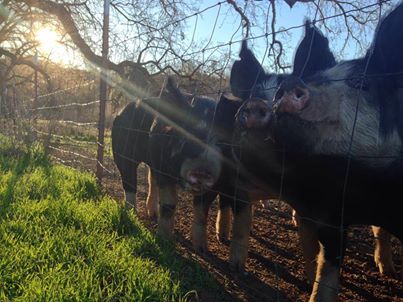
pigs and fence

Standard
Uncategorized

Pick Your Battles, Farmer Brown.

 There is no saying, as far as I know, that goes “thriving like a pig in an oak woodland.”  But there should be.  Watching the Berkshire hogs at Six Sigma Ranch shovel the black topsoil in the woods with their noses in search of acorns is a joy.  They’re even happier than the cows in the pastures, and certainly happier than the neighbor’s cows.  Since I am curious by nature, I wondered why.

Image
 Likewise, the grapes thrive.  There’s no place in the world better for growing grapes than Lake County (although our friends from Napa Valley, with whom Lake County shares a border, might argue for a tied game.)   The small beehive buzzes with enthusiasm.  But the apple tree by an old homestead near the tasting room only survives, and makes decent apples most years, but they’re not world-class.

 This made me think.  What do pigs, grapes and bees all have in common, that apples and cattle don’t?  They were here when we got here!  Lake County is home to wild pigs, wild grapes and wild bees.  And those all do great when we plant them on purpose.  But there are no wild apple trees or bovines here.  This seems obvious now, but I never thought about it as a rule for farming before:  When faced with a new plot of land, what should you plant?  Start with what’s already there!  Trying to make a living growing apples in our Mediterranean climate?  That would be a waste of time. 

On that note, Lake County is full of wild turkeys and quail.  So you might see some pastured poultry with a Six Sigma logo on it in the future.  And the blackberries invading the sheep pasture suggest that jam would be a good idea.  It sounds like we will have plenty of options for Farm-to-Table dinners in the next few years.

Christian

Standard
Uncategorized

How to Price a Product (Part 2/2)

The second aspect of pricing a product, then, is “what do you need to make?”  There’s room for some artistic license here, but “two times variable costs” is a good rule of thumb.  To explain, let’s start with two definitions:

Fixed Costs:  The money it takes to run your farm or business, without ever making a product.  This includes property taxes, building maintenance, and most electricity bills.  Conveniently, in a small farm, many of the fixed costs are part of running your household anyway. 

Variable Costs:  These increase when you make a product.  For example, chicken feed for broilers is a variable cost.  It increases only when you’re feeding a chicken for sale.  Packaging for eggs is also a variable cost.  Labor directly related to production is a variable cost, like the hourly rate for feeding the chickens. 

Lets go back to the egg example, a dozen eggs selling for $6.  As mentioned before, the variable cost (also known as cost of goods sold in this case), should be half of the selling price.  Thus, if you can make a dozen eggs with $3 in variable cost, and sell it for $6, you make a $3 gross profit per dozen, and should be decently happy with yourself. 

The gross profit, of course, exists to first absorb your fixed costs (if you sell 1,000 dozen eggs, your gross profit can absorb $3 x 1,000 or $3,000 of fixed costs).  Once your fixed costs are absorbed, the rest is PROFIT!

To summarize, (1) the market determines price in direct competition.  You determine price when you have a unique product that customers want.  (2) You should be happy to sell your product for two times the variable costs you spent to produce it.  And (bonus), once your gross margin (the money left over after variable costs are covered) exceeds your fixed costs, you make a profit!

That’s a mouthful, I know.  Write me a note or a comment with any questions!

Christian


Standard
Uncategorized

How to Price a Product (Part 1/2)

“If I sell eggs and lose $1 per dozen, how many dozen do I have to sell to break even?”  It’s a silly question, of course, but I’ve seen countless well-meaning farmers try to answer it by trial-and-error, on their way to getting a job in town.

I’d rather ask, “if I sell eggs and make $3 per dozen, how many do I have to sell to quit my job in town and make my dream job my real job?”

What’s the difference between the two farmers asking the questions? One of them knows how to price a product for sale. 

There are two aspects to pricing any product:

1.  What will the customer pay?

2.  What do you need to make?

Let’s start with the first one, “what will the customer pay?”  It’s really the most important, because it doesn’t matter what you need to make on a product if no customers will buy it at that price.  To begin, consider existing pricing in the market for products similar to yours.  If three farmers in your town are selling a dozen eggs for $6, that’s probably what people will pay.  Its not likely, if your eggs cost $9, that people will buy them.  That is, UNLESS (and this is a BIG idea when it comes to small business strategy) your product is BETTER.  If all the farmers in your town are selling eggs (pasture raised) for $6, you can charge more money if you offer something better, like pasture raised PLUS organic certification.

A strategic aside:  The best businesses in the world grow not by offering incremental improvements on existing products in the market, but by offering something completely different.  A famous egg farmer in Italy sells his eggs for $18/dozen.  How?  His chickens roost in trees.  He feeds them organic grains raised on the property and soaked in milk from a goat herd that exists only for the chickens.  He spends several hours each day hunting for eggs in trees, on buildings, and in shrubs.  And he’s happy to have help from every journalist and high-end restaurateur who wants to join him.  His product is better.  It’s more fun, and has NO EQUAL.  In that case, he gets to be more creative with the price.  (The opposite, of course, is what economists call “perfect competition.”  The best example is corn sold to the co-op; all suppliers bring an equal product, and the market dictates the price.  This environment is bad news, and best suited for going out of business unless you are the most efficient producer in the market.)

Standard
Uncategorized

5 REASONS WHY YOU CAN AND SHOULD START A FARM

I love America.  There’s an entrepreneurial spirit here, a can-do attitude that has impressed me since I moved here as a kid from Denmark.  In many countries, exposing a business idea in public results in a list of reasons why it can’t or shouldn’t be done.  In America, sharing a business idea often results in encouragement and an offer by a stranger to provide capital.

And within this environment of entrepreneurship, there is no better business to start than a farm.  Here are 5 reasons why:

1.  You can start a farm for the price of your daily Starbucks habit.  If you own a yard, you can grow something.  If you don’t own a yard, you can likely talk a landowner into lending you a corner in exchange for produce.  Seeds are cheap.  And, very likely, you’re already buying water and fertilizer for your lawn.   Sell your first tomato crop to buy a beehive.  Sell the honey and buy a chicken coop.  You get the idea.

2.  You can eat the inventory.  This one is important.  If you start a keychain factory in your garage, there’s a limit to how many keychains your friends and family can utilize in the event that it goes bust.  But, if you start an agricultural operation at a reasonable size, and don’t sell anything, you just cut down on your family’s grocery budget.

3.  You can scale any size.  Sierra Nevada Brewing Co. started in a garage, and now makes a million barrels of beer per year (that’s 8-figure annual revenue, for anybody keeping score).  If you’re making the world’s finest jam from a quarter acre, you can expand as customers demand it.  If you get carried away with inventory, refer to the paragraph above.

4.  You’re changing the world.  Every small farm making delicious, healthy products gets us one step closer to a better world.

5.  It’s March, the beginning of the growing season.  Now go buy some seeds, if you haven’t already.  You should be planting something!

Christian Ahlmann

Standard